
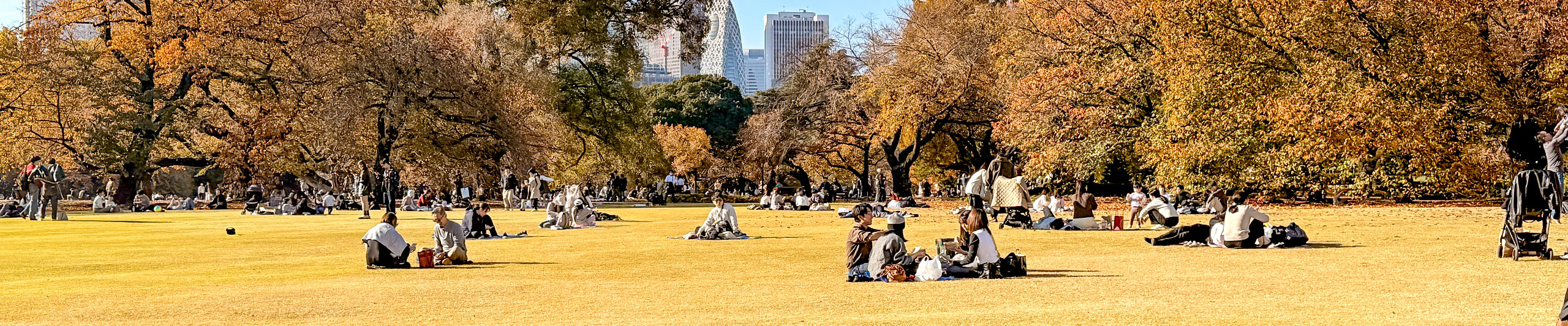

Japan Weather in November
November is one of the best visiting months with beautiful fall foliage and pleasant overall Japan weather. Most cities have mild temperatures and see low precipitation, and Hokkaido is the only region that has relatively chilly climate and experiences many rainy or snowy days.
Temperature
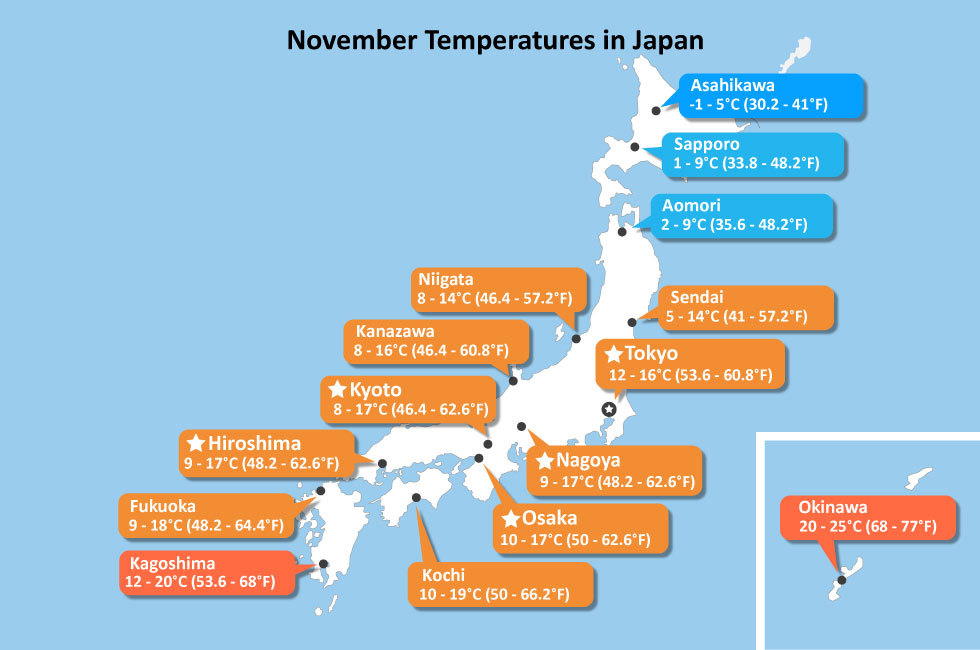
November, the final month of autumn, brings generally cool weather across Japan, though regional variations are pronounced:Cities in central regions of Japan, like Tokyo and Kyoto, enjoy temperatures favorable for outdoor exploration this month. During the first half of the month, temperatures range from 15-20 degrees Celsius (59-68 degrees Fahrenheit), and you will feel quite warm on sunny days. During the latter half, temperatures drop: daytime is cool at 10-15°C (50-59°F), and nighttime may feel slightly chilly, with temperatures around 5-10°C (41-50°F). Besides, higher elevations experience lower temperatures. For instance, Nagano sees daily highs of 5-15°C (41-59°F) this month, while daily lows are around only 0-5°C (32-41°F).
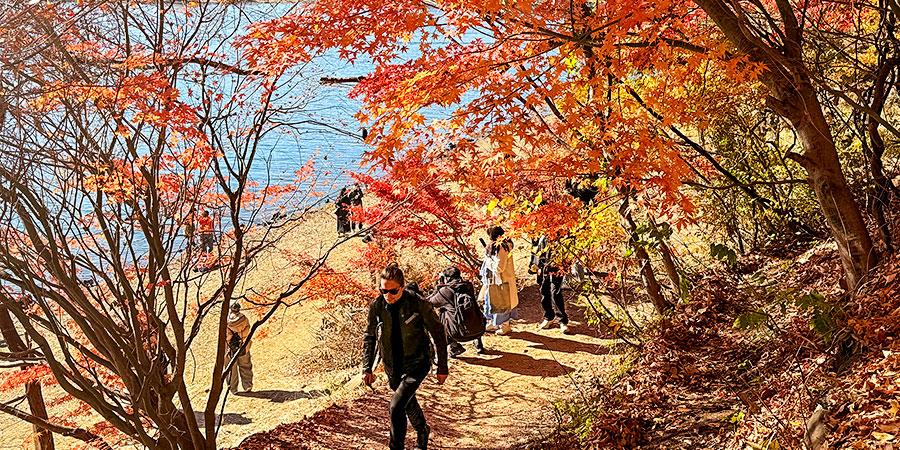
Overall Cool Japan in November
|
Moving northward, the weather generally turns colder. In Hokkaido, Japan’s northernmost region, temperatures range from 10-15°C (50-59°F) during the first half of the month, a still not-very-cold level. But by the second half, daily highs and lows drop to 5-10°C (41-50°F) and -5-5°C (23-41°F), respectively. In fact, it’s quite common for daily lows to dip below freezing during the latter half of the month, and occasionally, even the daily highs may fall below 0°C (32°F), making winter clothes necessary.
Moving to the southernmost region, the weather remains warm. For instance, in Okinawa, you might not even realize it’s autumn: Throughout the day, temperatures are around 18-24°C (64-75°F) before sunrise and after sunset and reach about 20-25°C (68-77°F) at their highest at noon.
Precipitation
Overall, November brings stable and sunny weather to most parts of Japan. The average precipitation for the month is 86 mm, with only 8 rainy or snowy days.Specifically, cities in the central region like Tokyo and Kyoto experience some of their lowest monthly precipitation levels of the year. These areas primarily see light rain that has minimal impact on travel but may lead to slight temperature drops. Moderate to heavy rain is of low possibility. Southern regions like Okinawa also see many sunny days, though the precipitation is slightly higher than that of the central areas.
Northern regions, like Hokkaido, present a distinct precipitation pattern. The precipitation is mainly in the form of rain in the first half month but snow in the second half, after all, the temperatures are much lower in this region. However, snow typically melts quickly, and Hokkaido usually does not experience significant snow accumulation this month. The overall precipitation is higher in this region, and the average total number of days with rain and snow in Hokkaido is around 15 in November.
|
|
|
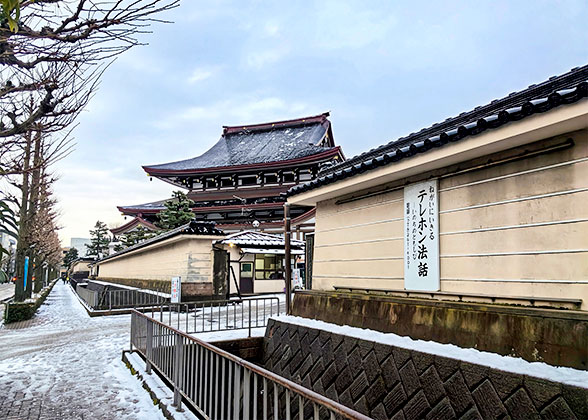
Daylight Hours/Sunshine Hours
In November, daylight hours in Japan grow progressively shorter, with dusk arriving earlier each day. Southern regions like Okinawa still enjoy relatively ample daylight. Sunrise and sunset occur around 06:38-06:58 and 17:36-17:47, respectively, with daytime hours decreasing from 11 to 10.5 hours. In central regions like Tokyo, sunrise delays from 06:03 to 06:32, while sunset advances from 16:46 to 16:28, reducing daylight hours from 10.5 to 10 hours. In northern areas such as Hokkaido, daytime lasts around 10 hours at the beginning of the month but drops to only about 9 hours by the month’s end. Sunrise times are not particularly late, at 06:08-06:44. However, sunset occurs very early, at 16:01-16:26. For travelers visiting Japan this month, the top priority is planning in advance and getting up early to make the most of daylight hours.Due to higher precipitation, the average sunshine hours this month are only about 3 per day in Hokkaido. Except for it, all other regions can enjoy an average of 4-5 hours of sunshine daily.


Best Time to Enjoy Fall Foliage
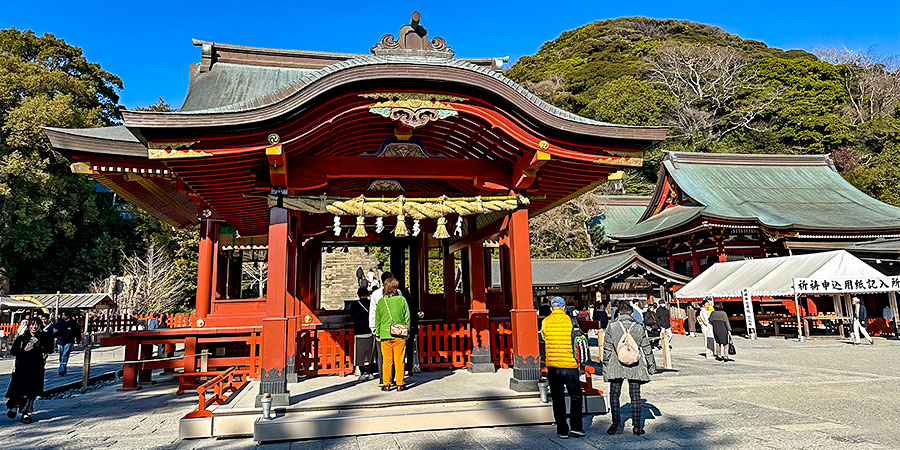
By November, fall foliage across most regions of Japan reaches its peak. Not only maple trees, but also ginkgo, beech, and other trees display vibrant colors, creating a colorful scenery of red, orange, gold, and yellow. No matter when you visit Japan this month, you can find perfect destinations to view these attractive leaves:
Spectacular Autumn View
|
Early November:
Leaves in the Tohoku region, like Aomori, are at their peak. High-altitude areas of central Japan, like Nagano and areas near Mount Fuji, also offer an extensive scale of autumn foliage, while low-altitude areas are just beginning to see leaves changing their color.
 Where to See Autumn Leaves:
1. Kawaguchiko Maple Leaf Corridor: You will find a 500-meter tunnel of maple trees, which will be illuminated by light at night.
2. Lake Towada in Aomori: You can witness mountains cloaked in vibrant autumn hues against a backdrop of azure skies and the shimmering blue lake.
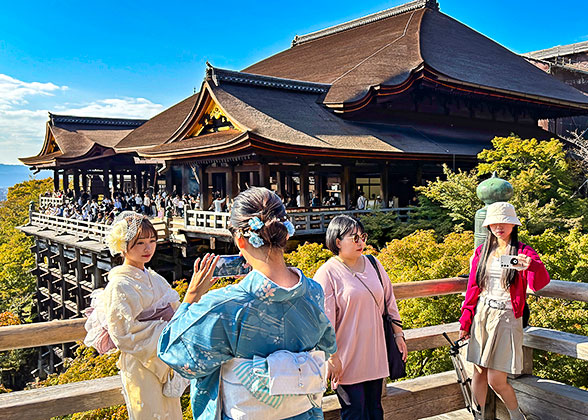
Red Leaves in Kiyomizu-dera Temple
|
Mid- to Late November:
Most regions of Japan, including central areas like Tokyo, Osaka, and Kyoto, as well as southern locations like Kagoshima, boast colorful and stunning autumn leaves to see.
Where to See Autumn Leaves:
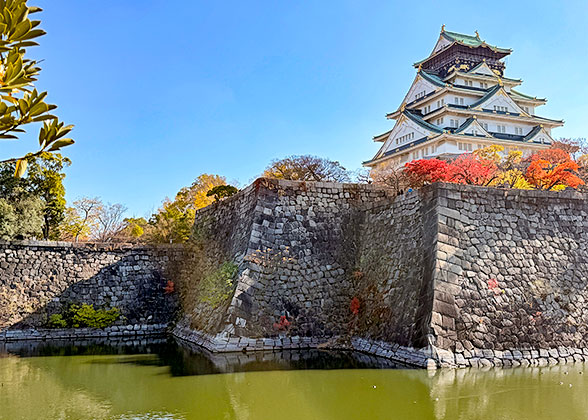
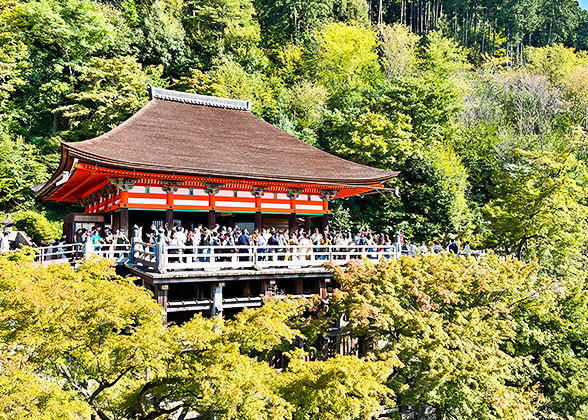
Popular destinations include Arashiyama, Tofuku-ji Temple, Eikando Zenrinji Temple, and Kiyomizu-dera Temple in Kyoto; Nara Park and Todaiji Temple in Nara; Shinjuku Gyoen National Garden and Rikugi-en Garden in Tokyo; and Osaka Castle Park in Osaka.
You May Like: Japan Fall Foliage Forecast
Crowds and Costs of Visiting Japan in November
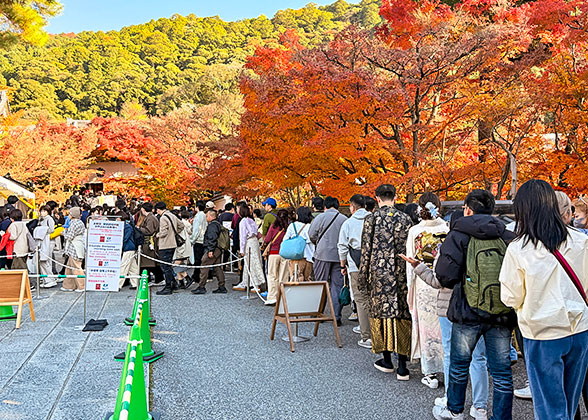
November is the prime month for viewing autumn foliage in Japan, so most cities and scenic areas will see a large number of tourists. You will inevitably feel crowded, especially at popular red-leaf viewing spots. At the same time, air tickets and hotels become both expensive and difficult to book. For instance, during the peak viewing period, hotel prices in Kyoto can soar to two or three times their usual rates.
However, Hokkaido, where autumn leaves have mostly fallen and snow has yet to accumulate, and Okinawa, devoid of autumn foliage and no longer suitable for swimming at this time, are off-season destinations in November. They attract fewer visitors and offer lower costs.
|
|
|
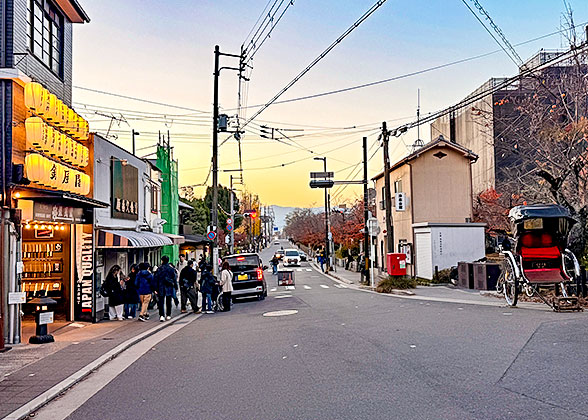
Is November A Good Time to Visit Japan?
Yes, and November is one of the best months to go to Japan. Why?
1. Japan climate is exceptionally pleasant in November. Most regions experience warm or cool temperatures, and Hokkaido is not so cold. Skies are generally clear with low or moderate rainfall.
2. This is the peak season for autumn foliage in Japan.
3. With its clear air and high visibility, November serves the best viewing period for Mount Fuji, whose summit is already covered in snow at this time. Moreover, you might even witness both the autumn leaves and Mount Fuji at the same time.
4. This month, Christmas decorations have appeared in many regions of Japan, and Christmas markets have begun in some places.
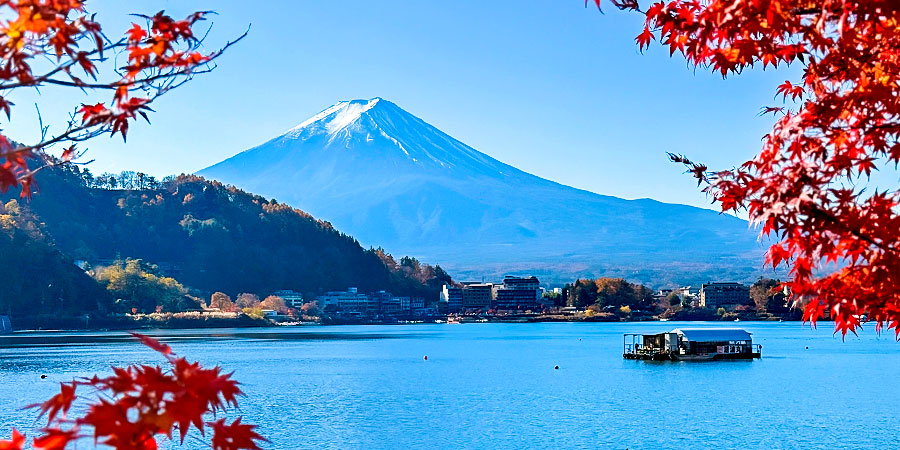
Mount Fuji with Red Leaves
|
Packing List for Visiting Japan in November 2026
|
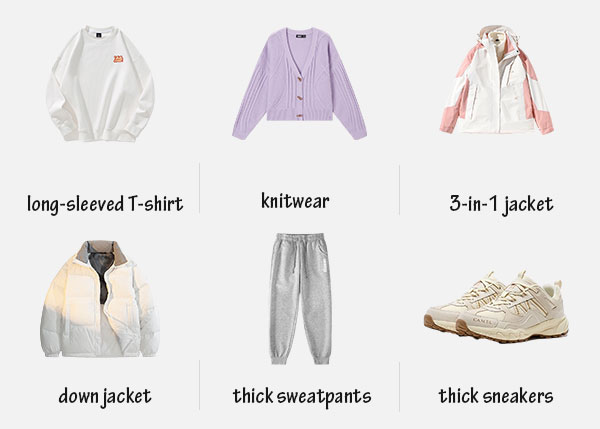
Clothes: When visiting southern cities like Okinawa or Naha, you can wear short-sleeved or long-sleeved T-shirts with thin pants on sunny days. For rainy days or evenings, light jackets are needed.In central cities like Tokyo, the first half of the month calls for long-sleeve T-shirts, jeans, and a windbreaker. During the latter half, the aforementioned outfit may still suffice at times, but sudden temperature drops can make a coat essential.
If you plan to visit northern regions like Hokkaido, packing winter clothing is essential. For the inner layer, choose thin hoodies or sweaters, as indoor spaces can be quite warm thanks to air conditioning. For outerwear, bring both 3-in-1 jackets and down coats, so that you can adjust the thickness of your outfits per day according to the temperatures. When packing pants, opt for windproof and warm outdoor pants.
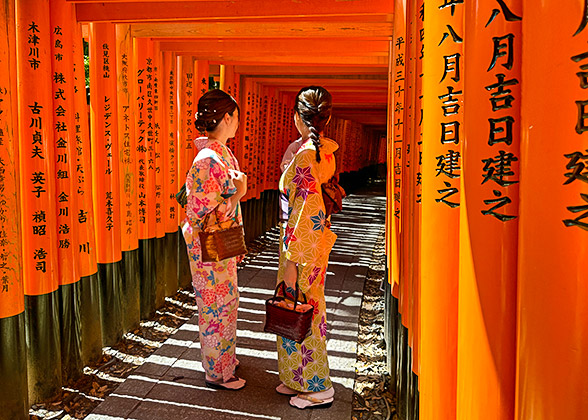
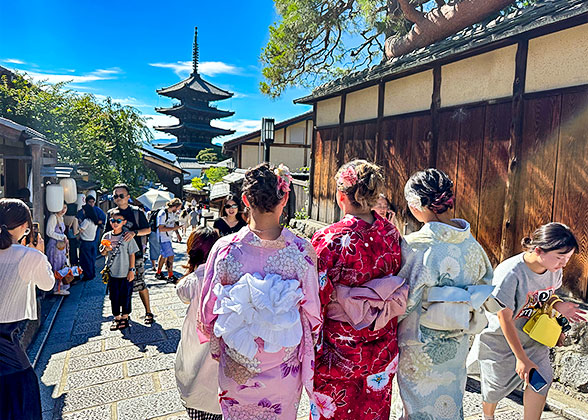
Besides, it’s worth mentioning that in this month with overall cool climate and beautiful fall leaves, it’s a good idea to experience wearing kimonos.
Shoes: When traveling to Hokkaido, bring thick boots; while visiting other destinations, thick sneakers or casual shoes are sufficient. Others: For trips to Hokkaido, it’s also recommended to bring hats and scarves for warmth.
Tips for Visiting Japan in November
1. November is crowded with tourists throughout the entire month, so it’s best to book your hotel and flights several months in advance.
2. Some popular autumn foliage viewing spots require advance reservations. For instance, in 2025, to visit Kyoto’s Ruriko-in Temple during its peak autumn foliage season from November 8th to December 7th, reservations must be made in September. Therefore, if you intend to enjoy autumn leaves in Japan in 2026, be sure to check the official information for each attraction well in advance to confirm whether reservations are required.
3. To have a better travel experience, try to avoid visiting Japan during the weekends of November. During these times, major Japanese cities attract not only foreign tourists but also large numbers of domestic travelers, leading to even more crowded attractions and higher hotel prices. Additionally, mornings generally see fewer crowds, so you are recommended to arrive at your destinations early per day to enjoy relatively quiet trips.
4. Note that the peak autumn foliage viewing period varies annually. First, research the predicted best viewing times for different regions in Japan before finalizing your itinerary dates. Second, reconfirm related forecasts closer to your departure date, and adjust your itinerary promptly if necessary to catch the most vibrant foliage.
5. Hokkaido this month may not offer thick snow cover. If you wish to see snowy landscapes or enjoy snow sports, late December onwards is a more suitable time.
6. If you want to wear kimonos, you are advised to make reservations in advance, since the kimono experience is a popular activity during the peak fall foliage season.
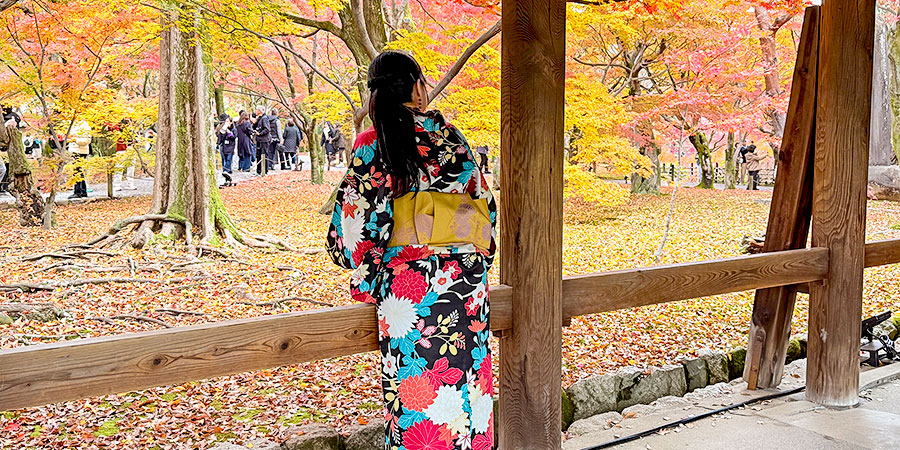
Tourists Wearing Kimonos
|
November Weather of Japan's Major Cities
|
November |
Temperature | Sunrise / Sunset |
Humidity (%) |
|
| High | Low | |||
|
Aomori |
9°C / 48.2°F | 2°C / 35.6°F | 06:22 / 16:20 | 76 |
|
Asahikawa |
5°C / 41°F | -1°C / 30.2°F | 06:13 / 16:02 | 79 |
|
Fukuoka |
18°C / 64.4°F | 9°C / 48.2°F | 06:48 / 17:16 | 68 |
| Hakata |
17°C / 62.6°F |
7°C / 44.6°F |
06:37 / 17:27 | 67 |
| Hakodate |
9°C / 48.2°F |
1°C / 33.8°F |
06:10 / 16:33 | 71 |
|
Hakone |
17.5°C / 63.5°F |
7.1°C/ 44.8°F |
06:17 / 16:40 |
76 |
| Hirosaki | 9°C / 48.2°F | 3°C / 37.4°F | 06:25 / 16:22 | 82 |
|
Hiroshima |
17°C / 62.6°F | 9°C / 48.2°F | 06:42 / 17:06 | 65 |
|
Kagoshima |
20°C / 68°F | 12°C / 53.6°F | 06:44 / 17:19 | 67 |
|
Kamakura |
16°C / 60.8°F | 10°C / 50°F | 06:03 / 16:47 | 57 |
|
Kanazawa |
16°C / 60.8°F | 8°C / 46.4°F | 06:30 / 16:45 | 69 |
|
Kobe |
17°C / 62.6°F | 9°C / 48.2°F | 06:19 / 17:05 | 66 |
|
Kochi |
19°C / 66.2°F | 10°C / 50°F | 06:37 / 17:04 | 43 |
|
Kyoto |
17°C / 62.6°F | 8°C / 46.4°F | 06:30 / 16:52 | 66 |
|
Lake Kawaguchi |
12°C / 53.6°F |
0°C / 32°F |
06:20 / 16:41 |
79 |
| Mount Fuji | 14°C / 57.2°F | 2°C / 35.6°F | 06:18 / 16:46 | 74 |
| Nagasaki | 18°C / 64°F | 13°C / 55°F | 06:49 / 17:20 | 68 |
|
Nagoya |
17°C / 62.6°F | 9°C / 48.2°F | 06:25 / 16:47 | 66 |
| Nara |
17°C / 62.6°F |
8°C / 46.4°F |
06:29 / 16:51 |
66 |
|
Niigata |
14°C / 57.2°F |
8°C / 46.4°F |
06:23 / 16:33 |
71 |
|
Nikko |
10°C / 50°F |
1°C / 33.8°F |
06:04 / 16:44 |
70 |
|
Okinawa |
25°C / 77°F |
20°C / 68°F |
06:47 / 17:40 |
68 |
|
Osaka |
17°C / 62.6°F |
10°C / 50°F |
06:31 / 16:54 |
58 |
|
Sapporo |
9°C / 48.2°F |
1°C / 33.8°F |
06:26 / 16:13 |
67 |
|
Sendai |
13°C / 55.4°F |
5°C / 41°F |
06:17 / 16:25 |
68 |
| Shirakawa-go |
13°C / 55.4°F |
3°C / 37.4°F |
06:46 / 16:39 | 85 |
| Shizuoka |
18°C / 64°F |
9°C / 48.2°F |
06:23 / 16:44 | 71 |
|
Takayama |
13°C / 55.4°F |
3°C / 37.4°F |
06:29 / 16:48 |
72 |
|
Tokyo |
16°C / 60.8°F |
12°C / 53.6°F |
06:16 / 16:34 |
57 |
| Wakayama |
18°C / 64°F |
11°C / 52°F |
06:31 / 16:56 | 68 |
| Yokohama |
17°C / 62.6°F |
10°C / 50°F |
06:53 / 17:17 | 64 |