

Mongolia Weather
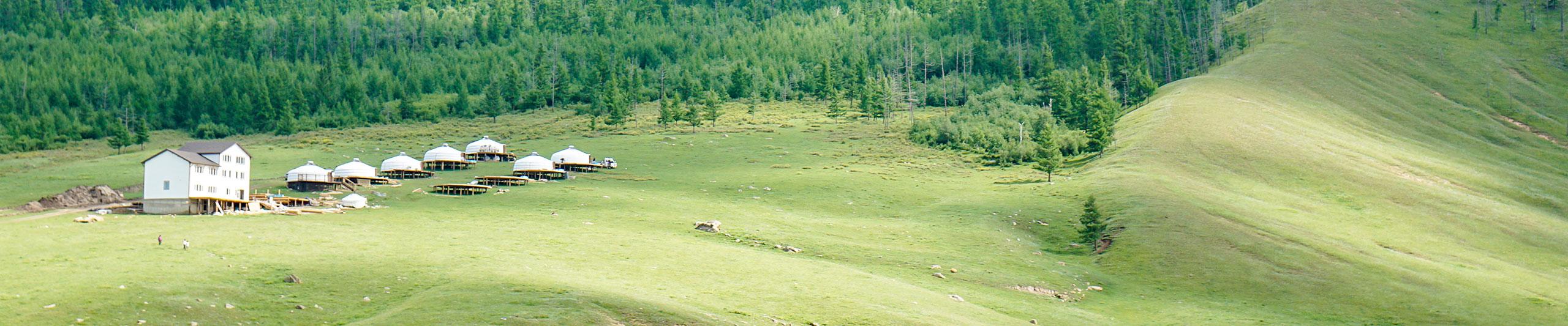
Mongolia, an inland country surrounded by China and Russia, belongs to the continental temperate grassy climate zone. It has an extremely long and freezing winter from November to April, and a cool but short summer from July to August, with the transient spring and autumn as the transitional periods. The vast grassland in Mongolia turns green and virid from June to September, bringing a big feast to your eyes. Due to the geographical location far away from the ocean, Mongolia weather features dryness, less rainfall, abundant sunlight hours, and large day-night temperature difference. Blizzard occurs in mid-winter and sandstorm are commonly seen in March. Overall, the climate of Mongolia is unstable and should be frequently paid attention to if you are going to travel there in 2026.

Large Temperature Fluctuations Both Yearly and Daily
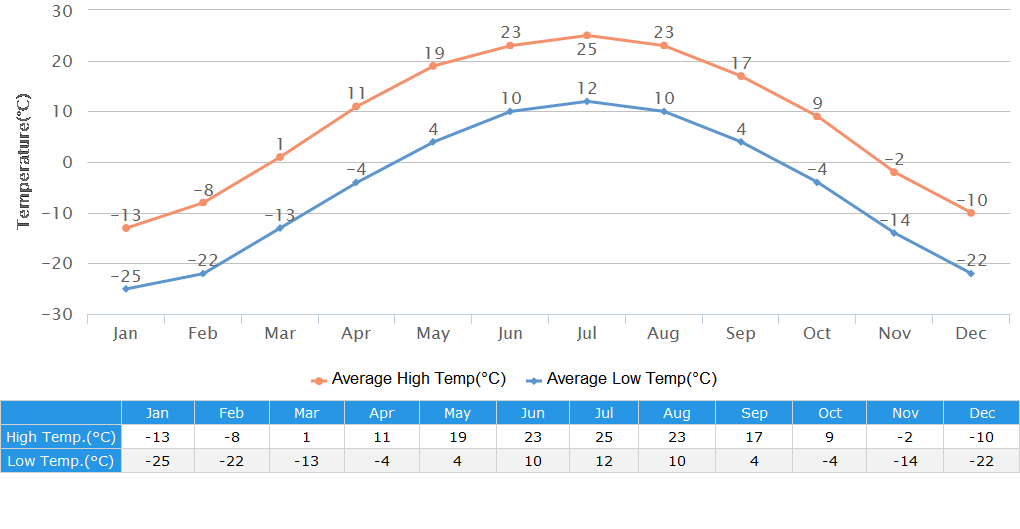
Mongolia temperature is of dramatic fluctuations throughout the year, with the highest temperature of over 35 degrees Celsius (95 degrees Fahrenheit) in summer and the lowest -40℃ (-40℉) in winter. Moreover, the temperature difference in one day is large as well, especially for spring and autumn. The most common day-night temperature difference lies between 15 and 20℃ (59-68℉), and the largest even reaches to 30℃ (86℉). It is possible for visitors to wear their T-shirts at noon, but have to put their cotton coats on in the night.
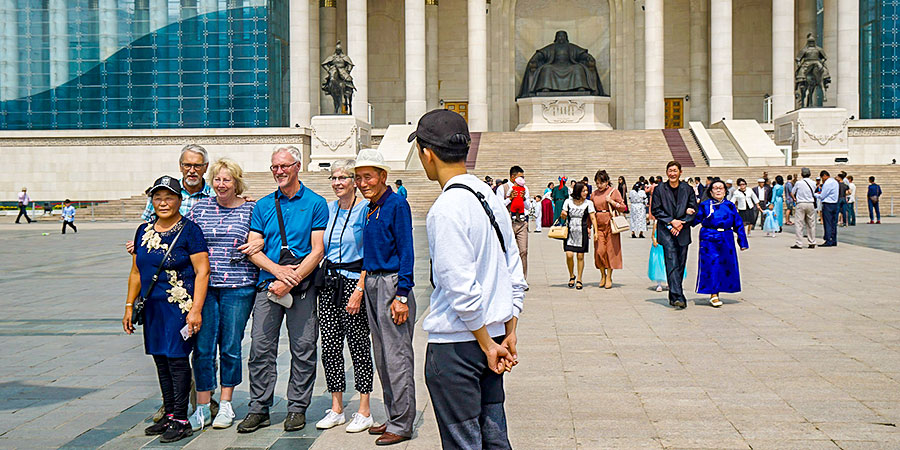
Visiting Mongolia in Summer
|
What is the Coldest Month in Mongolia?
The coldest month in Mongolia falls in January. Even the high temperature hovers around only -10℃ (14℉), let alone the low temperature, which can drop to -40℃ (-40℉) and once to the historically lowest -60℃ (-76℉). Considering the weather of Mongolia in this month is severely cold, it is not recommended to conduct long-time outdoor activities.
What is the Hottest Month in Mongolia?
July is the warmest month in Mongolia. Even though, Mongolia’s weather is not too hot with highs generally below 30℃ (86℉) and occasionally reaching over 35℃ (95℉). In the night and early morning, it is quite cool and pleasant as the low temperature remains only around 13℃ (55℉). But still, for those sensitive to hot wave, you are suggested to schedule some indoor activities at noon, and outdoor activities in the cooler morning and afternoon, so as to have a better and happier experience.
Low Precipitation
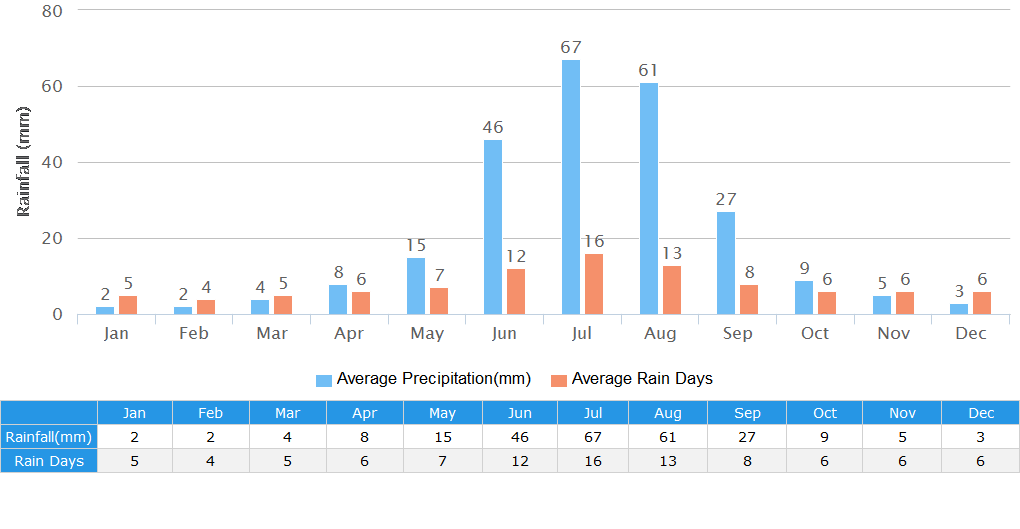
The annual average precipitation is around 200mm (8 in), scare and concentrated primarily in June, July and August. In a year, rainy days are less than 90 days, including 8 to16 days per month from May to September, and less than 5 days for other months. Regionally, it declines gradually from 200-400mm (8-16 in) in Northern and Central Mongolia where rivers and mountains are located, to 100-150mm (4-6 in) in Southern Mongolia of which deserts are the main part.
Abundant Sunlight Hours
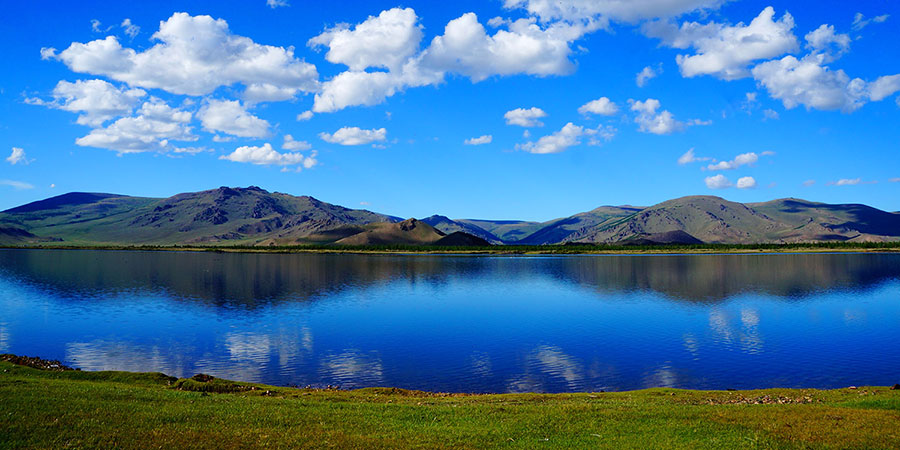
Mongolia, known as the “Country of Blue Skies”, boasts abundant sunshine, whose annual sunlight hours reaching 2,600-3,400 hours with more than 250 sunny days throughout the year. With bright sunshine, the vast landscape of Mongolia, under the azure sky and white clouds, looks more appealing no matter in lively summer or in snow-covered winter. However, its UV index is relatively high, peaking at grade 8 in summer, a very high level which may cause sunburn if taking no protection measures while staying outdoors for a long time.
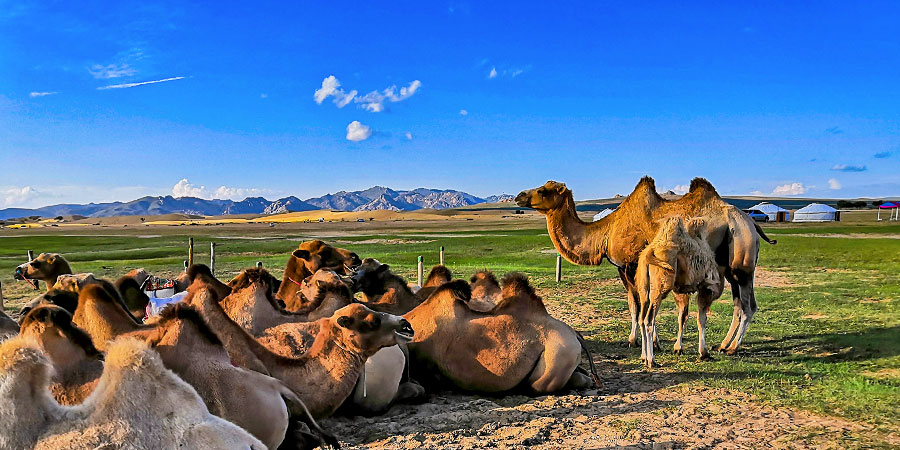
Sunny Mongolia
|
Blizzard and Sandstorm
The large-scale sandstorm in Mongolia most happens from March to May, which will lower the air quality and restrict the visibility, making the outdoor activities challenging. In recent years, the sand-dust storm once came earlier in January or February. It is advisable for visitors to avoid outdoor activities when encountered heavy sandstorm.
The blizzard might rage from December to February. During the snowstorm period, it is of great possibility that the flights, trains and buses are delayed or cancelled, and that the highway and road are closed to traffic. Therefore, it is necessary to check climate forecast frequently and pay closer attention to the warning information if you plan to visit Mongolia during this period.
What is the Best time to Visit Mongolia?
The best time to visit Mongolia must be June to September.
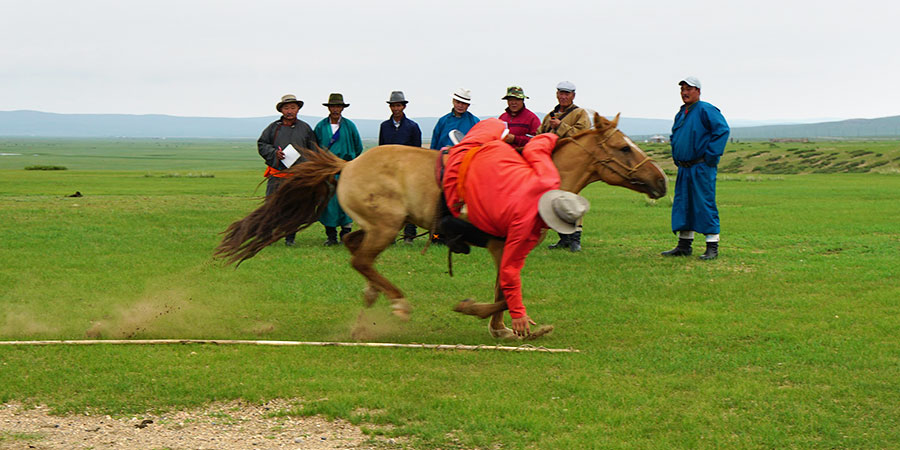
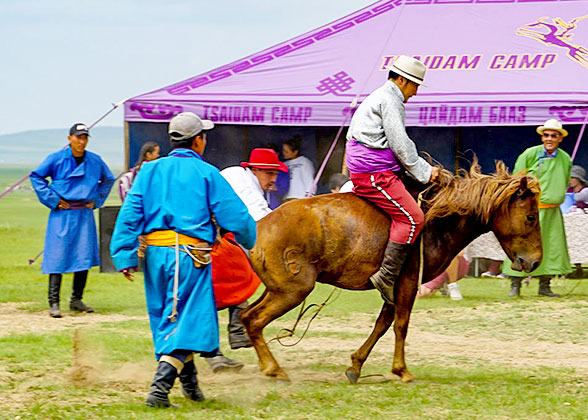
The weather from June to August is warm and pleasant, allowing visitors to have outdoor activities comfortably. It is during this period that the boundless grassland comes back to green and presents its most wonderful scenery for the visitors. In July or August, Naadam Festival, the most important and biggest traditional festival in Mongolia, will be held, when you can enjoy the exciting traditional races and impressive performance of horse riding, wrestling, archery and etc..
|
|
|
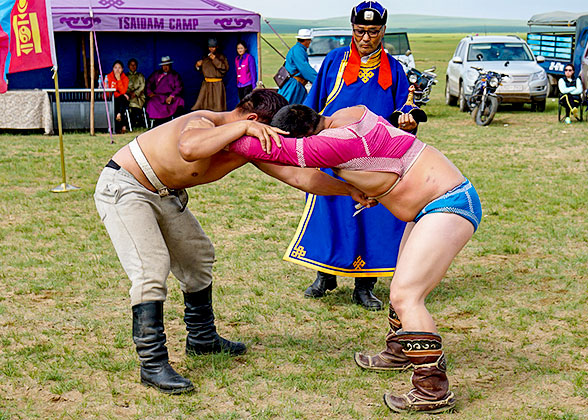
In September, the climate is cool generally, sometimes even chilly after the sunset. But wearing thick coats and sweaters, visitors could feast their eyes with the golden grassland and colorful tree leaves.
|
|
|
Mongolia Weather by Month
Mongolia Climate - Seasons & Travel Advice
Spring (May-June)
 Weather
In early spring, it still remains rather cold, though the minimum temperature keeps above 0℃ (32℉) when the snow cover and ice start to melt. Coming to late spring, the climate becomes quite warm with the high temperature fluctuating slightly around 21℃ (70℉). But the weather is not warming up stably and sudden climate changes are common that you may feel like experiencing different seasons in several days. The rainfall triples, from 15mm (0.8 in) in May to 46mm (1.8 in) in June, but heavy rain can be hardly seen. An umbrella is suggested but no worry if without one. The daylength increases to 14 and 15 hours, providing more day time for visitors to experience as much as possible.
What to BringClothes: long-sleeved T-shirts, hoodies, sweaters, trench coats, windbreakers, thin down coats; casual pants, long johns and jeans
Shoes: comfortable sneakers with thick socks
Tips1. The grassland just starts to come back to green in May, being light green mingled with yellow and brown, instead of being completely vibrant green.
2. Heating system stops service on May 15 when the weather is usually warm enough, but sudden temperature drops may still occur especially when strong winds hit. For peace of mind, book a hotel with air-conditioner.
3. Snow cover in most areas has melted in May but some areas like Western Mongolia where the Gobi Desert is located, might be the exception.
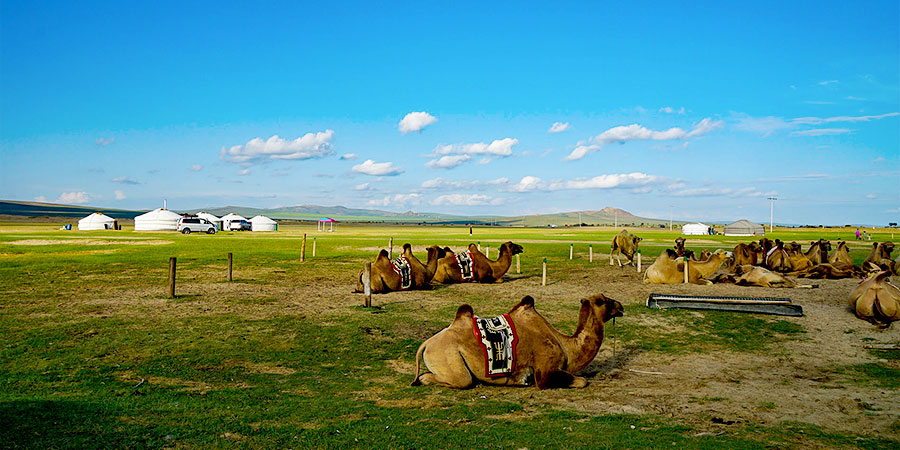
Grassland in Mongolian Spring
|
Summer (July-August)
WeatherThe high temperature in summer ranges from 20-28℃ (68-82℉) normally, and scorching hot days, influenced by the high altitude, are rare. However, there is large difference in temperature between day and night, with its peak of over 30℃ (68℉) and its bottom of 11℃ (52℉). Thin summer clothes are not enough to spend the cool night. Summer has the most rainfall of the year, with approximately 30 rainy days in the two months, but the total precipitation is not big compared with other world’s destinations, less than 150mm (6 in). Though heavy and sudden rainfall may occur in this period, drizzles and moderate rain are more common. The UV index in summer is very high, which means sun-protective items are necessary to prevent sunburn.
What to BringClothes: thin T-shirts, breathable sun-proof coats, blouses, trench coats, windbreakers; shorts, skirts, summer dress, casual pants
Shoes: comfortable sneakers, scandals
Others: umbrellas, sun scream, sunglasses, sunhat, a portable fan, mosquito repellent spray
Travel Recommendations & Tips1. Book flight tickets and hotel in advance since summer is the travel peak season.
2. Check the specific days of Naadam Festival which usually starts on June 4 in lunar calendar (July or August in solar calendar) and lasts for 5 days.
3. Visitors may crowd into Mongolia to join Naadam Festival, so book performance tickets in advance.
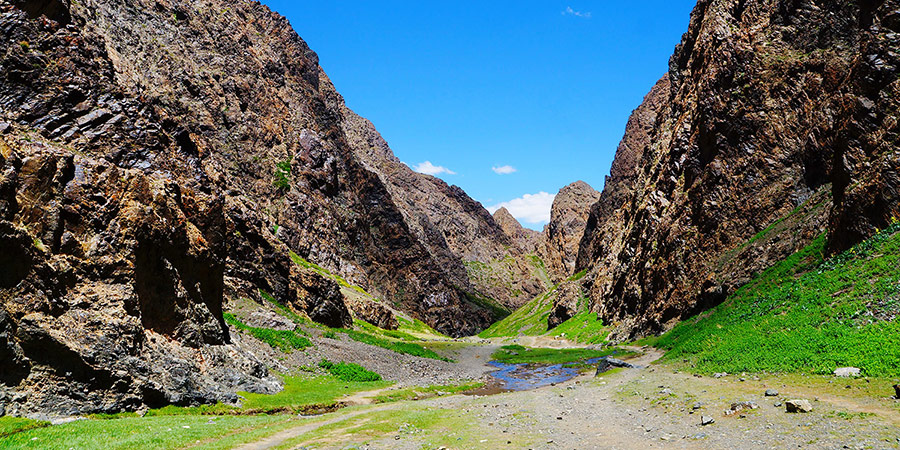
4. The grassland and forests turn to be the most abundant, luxuriant and verdant in summer, and Gorkhi-Terelj National Park is a good place to enjoy the view.
5. Ulan Waterfalls is in its high flow period, suitable for visiting.
6. Be careful about the mudslide caused by heavy rainfall especially if you are in the mountain areas.
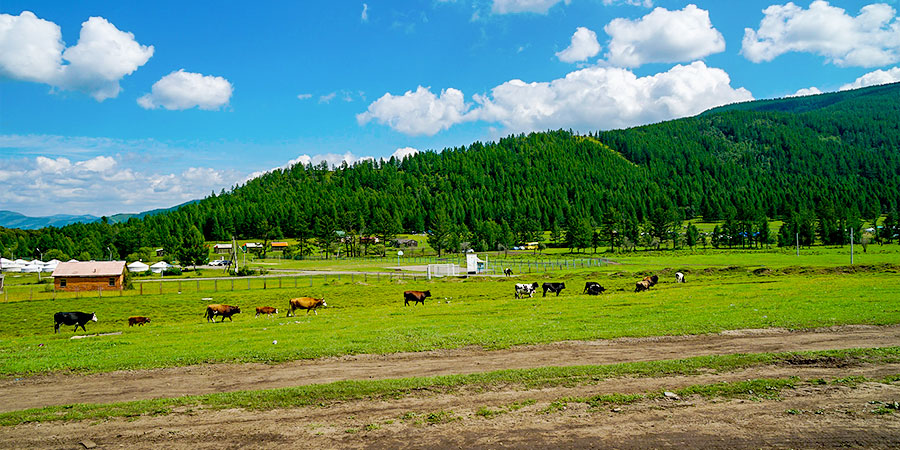
Terelj National Park in Summer
|
Autumn (September-October)
WeatherThe climate in autumn is cool and chilly, but not frigid. From September to October, the day-night temperature difference turns to be larger, ranging from 7℃ (44℉) to 18℃ (64℉). It’s still possible to enjoy a pleasant journey given that you wear enough to resist the moderate coldness.
What to BringClothes: sweaters, hoodies, thick jacket, windbreakers, down coats; padded jeans, thick sweatpants, down pants
Shoes: casual shoes with thick socks, walking boots
Tips1. The view of fall foliage appears only in the late September.
2. In the late autumn, Lake Khövsgöl starts to freeze, but the ice is not thick enough to walk on.
3. The heating system in Ulaanbaatar is put into service on September 15, so it is not cold indoors.
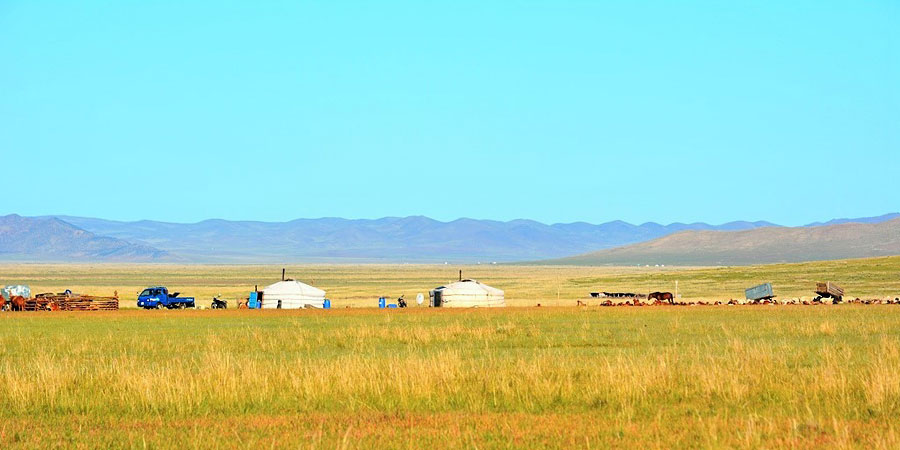
Golden Autumn in Mongolia
|
Winter (November- Next April)
WeatherGenerally speaking, the Mongolia weather in winter is frigid and freezing. Almost the whole winter lasting for half a year remains below -10℃ (14℉). Snowy days in the winter are seldomly seen and the precipitation is less than 27mm (1 in), thus making the climate so dry and arid that maintaining moisturized is vital. It’s not until April that it gets a bit warm with the high temperature going above 8℃ (46℉). In winter, visitors could run into snowstorms accompanied by strong winds in many areas of Mongolia. Meanwhile, sandstorms could hit the Mongolian land, especially in March.
What to BringClothes: soft and warm long-sleeved shirts for the inner layer, heavy sweaters, padded jacket, thick down coat; scarves, gloves, woolen hats; fleece pants, padded jeans, down pants
Shoes: thick non-slip sneakers, snow boots
Others: masks, warm pastes, moisturizers
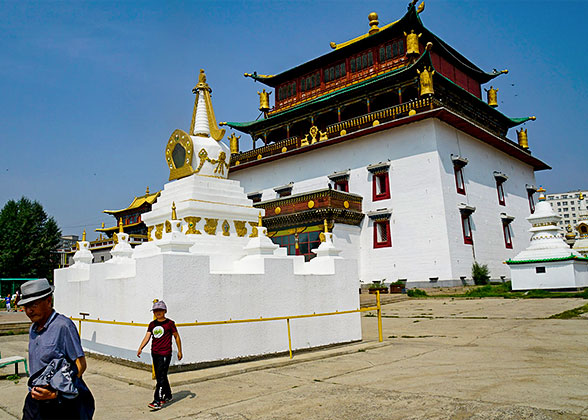
Gandan Monastery in Ulaanbaatar
|
Travel Recommendations & Tips1. Winer is the good time for ice and snow sports such as skiing in Jankhai Mountain, ice fishing and skating on frozen Moron River.
2. Go to the State-owned Department Store in Ulaanbaatar if you are short of thick clothes.
3. Activities indoors are recommended, including visiting the Genghis Khan Museum, Winter Palace of the Bogd Khan, and Ganden Monastry.
4. The air quality might be poor in winter when the heating is powered by coals, so you had better wear masks and prepare some drugs if you suffer from asthma.