

Karakorum Weather
Karakorum, 365km (227 mi) southwest away from Ulaanbaatar, is situated in the central region of the Mongolian Plateau and belongs to continental climate zone. It experiences four distinct seasons, but the seasonal transition is sudden. The weather of Karakorum in summer is pleasantly warm, making July to August the peak travel season. Winter is long and cold. Spring and autumn are short and relatively mild. Meanwhile, it enjoys rich sunshine in the most of the year, even during the exceptionally frigid winter.
Temperature
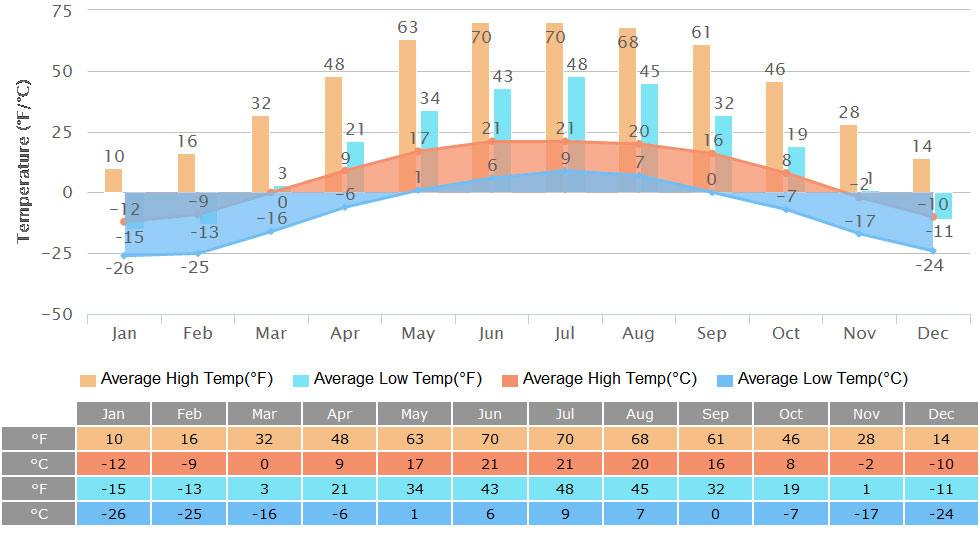
The temperature in Karakorum fluctuates drastically throughout the year as the daytime high temperature ranges from -20 to 6 degrees Celsius (-4 - 43 degrees Fahrenheit) in winter and hovers around 25℃ (77℉) in summer. A large yearly temperature difference can be seen and the same is true for that between day and night. When it blows or rains, significant temperature drops occur.
High/Low Temperatures of Karakorum
What is the Coldest Month in Karakorum?
There is no denying that January is the coldest month in Karakorum. Mostly, the high degree swings between -18 and -9℃ (0 - 16℉) and low between -28 and -19℃ (-18 - 2℉). However, even lower daytime temperature around -24℃ (-11℉) once happened. Therefore, Karakorum weather in January can be described as bitterly cold and your skin gets numbly painful after being exposed to the cold air for one minute only.What is the Hottest Month in Karakorum?
July is the hottest month in Karakorum when the daily high normally lies between 18 and 27℃ (64 - 81℉) and the nighttime low between 8 and 15℃ (46 - 59℉). Compared with most other destinations in the world, the climate of Karakorum is comfortably warm even in the hottest month, making it a good destination to escape summer heat. After night falls, it turns a little cool but remains pleasant if you put on a jacket.Precipitation
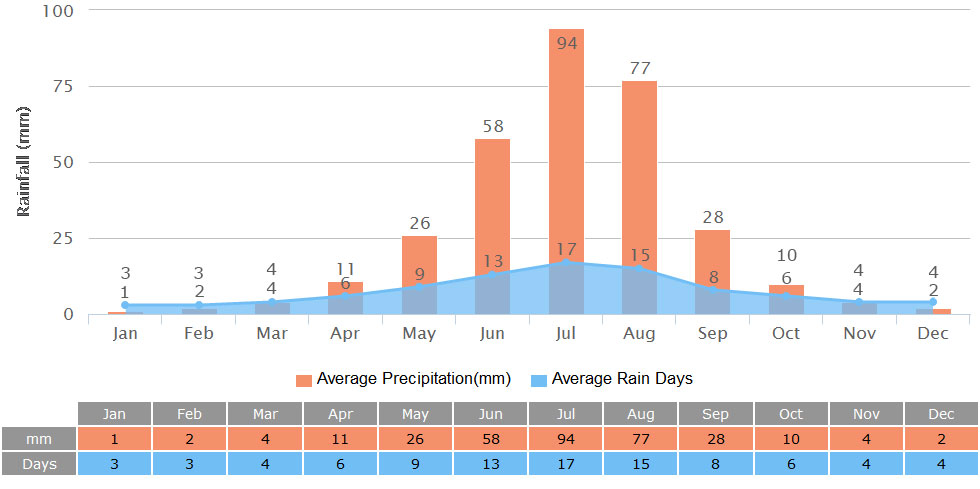
On average, Karakorum receives the annual precipitation of 317mm (12.5 in), distributed over 92 days. With high evaporation capacity and relatively scarce rainfall, Karakorum is quite arid and drought in most time. Only in its rainy season which lasts from June to August, the humidity lies in a moderate range that you don’t feel dry, but not damp either. The monthly rainfall is the most in August, though still pretty low, which means your travel won’t be disrupted largely.
Rainfall of Karakorum
Sunlight
Karakorum is endowed with abundant sunlight, with no less than 6 hours of sunshine daily on average, creating a favorable weather condition for outdoor visits. June sees the most plentiful sunshine and longest daytime of the year, 10 sunny hours out of 16 hours’ daytime. The UV index is relatively high, especially in spring and summer. Considering the vast landscape with few sheltering and shady places, you had better pay special attention to take protection measures and protect yourself from sunburn.Best Time to Visit Karakorum
June to September is a golden time to visit Karakorum when it enjoys moderate temperature and humidity. In specific, from June to August, it is warm and cozy overall, then turns pleasantly cool in September. Moreover, natural views are also at their best time, including the vast green grassland, vibrant Orkhon Valley and magnificent Ulan Waterfall. Besides, festivals and activities are usually held in July including the Yak Festival and Naadam Fair, when visitors can appreciate the brilliant competitions and experience the local customs in depth.
 Read more: Best Time to Visit Mongolia & Mongolia Weather
Karakorum Climate - Seasons & Travel Advice
Spring: May - June
Weather
Spring arrives in Karakorum in May, as Karakorum climate gets warmer and warmer and everything comes back to life. However, sudden climate changes occur, especially in May when there might be even snow fall. You might be surprised to see that the high temperature plunges from 12℃ (54℉) to -7℃ (19℉) and surges to 24℃ (75℉) in one week. In June, Karakorum enters into rainy season, but rainy hours only account for a very small part.What to Bring
Clothes: You are suggested to prepare heavy clothes like sweaters and trench coats as well as thin summer clothes including T-shirts and long-sleeved ones. Casual jeans and long johns work well to deal with sudden temperature drops. Shoes: You can choose any shoes which are comfortable and suitable for long-distance walking. Others: Don’t forget sun-protective products like sunglasses, sunscreen cream and hats.Tips
1. Starting May 1, Erdene Zuu Monastery begins to follow summer time schedule and keeps open from 09:00 to 18:00 every day. But Karakorum Museum closes at 20:00.2. It is not until late May that vast green landscape can be seen in Karakorum. In middle May, there are still scattered bare grounds without plant cover. Coming to June, the grassland becomes more luxuriant.
Summer: July - August
Weather
Summer in Karakorum, known as the peak travel season, enjoys the most pleasant temperatures: the high temperature rarely exceeds 30℃ (86℉) and low value swings around 15℃ (59℉). It is cozy and warm at daytime, only a bit hot around the warmest noon. Gentle winds could bring away the sweat after long-time hiking and cool you down. However, it is susceptible to sunburn since the UV index is particularly high at level 9 in July.The rainy season reaches its peak in July with the average monthly precipitation of 94mm (3.7 in) and it decreases to 77mm (3.03 in) in August. But good news is that it mainly falls as drizzles or brief showers and heavy rain can be seen only occasionally. Though there are around 30 days with some rainfall, it keeps raining only for a short period instead of lasting for a whole day, thus causing limited influence on your travel schedule.
What to Bring
Clothes: Breathable and light-colored ones are most recommended, such as flax or chiffon T-shirts, thin sunscreen coats, loose summer trousers or shorts. Be sure to pack relatively thick clothes like jeans and jackets for rainy days when temperature drops obviously.Shoes: Breathable sneakers are the best choice, but they had better be water-proof and anti-slip in case of rain. Scandals are not suggested since the roads on grassland are rough and you might sprain your ankle. Others: You should bring sunglasses, sunblock and sunscreen hats to prevent strong ultraviolet rays. You might also need raingear and mosquito repellent spray.Travel Recommendations and Tips
1. Yak Festival is usually held on July 23 at Orkhon Valley and local Naadam Fair in mid-July. However, the exact dates in 2026 are unknown yet and there might be changes, so, please check before departure.2. July to August is the high flow period of Ulan Waterfall. With bright sunshine, visitors may have the chance to see colorful rainbow in the water mist.
3. Avoid visiting grassland and Orkhon Valley after heavy rainfall. Light rainfall matters little as long as your shoes are anti-slip.
Autumn: September - October
Weather
As the temperature starts to decrease gradually, Karakorum weather experiences great changes in autumn. With lingering heat in summer, it remains generally warm in the first half of September, turns cool in the late half and then becomes cold in October. Sudden temperature drop also occurs frequently and visitors should be prepared for the enlarging day-night temperature differences.Generally speaking, the autumn climate in Karakorum is dry. September sees a dramatic plunge in precipitation which signals the ending of rainy season. On average, there are around 7 rainy days monthly, bringing the average monthly rainfall of 28mm (1.1 in) or even less. It usually falls as light rain, but snow may visit Karakorum as well in autumn, although the snow scenery only lasts for one or two days this season.
What to Bring
Clothes: 3-in-1 windbreaker is a good choice in autumn since you can choose to wear its different layers according to actual temperature. Besides, it is suggested to bring hoodies, knitwear, trench coats, jeans and sweatpants. Thermal underwear and long johns should also be packed to deal with temperature drops.Shoes: Comfortable shoes with socks of different thickness are good matches.Others: It is necessary to bring masks, lip pomades and moisturizing cream. You may still need sun-protective products in September.Tips
1. Since October 1, Erdene Zuu Monastery and Karakorum Museum start to follow the winter time schedule with th opening time from 10:00 to 17:00 and 09:00 to 17:00 respectively. Remember that the fommer attraction keeps open every day and the later on are closed on weekends.2. The grassland grows increasingly yellow, then presents golden landscape in late September and early October, finally gets withered and brown in late October.
Winter: November - Next April
Weather
The winter in Karakorum is remarkably long, bitterly cold and pretty dry. From November to next February, even the maximum daytime temperature mostly stays below freezing and the nighttime degree ranges from -29℃ (-20℉) to -10℃ (14℉). Significant rise occurs in March and April when Karakorum transits from winter to spring.Meanwhile, the precipitation remains scarce, no more than 5mm (0.2 in) each month averagely except April. Visitors might feel so dry that your lips and hands get cracked if without full protection. It snows lightly in most time, but if combined with strong winds, it causes much inconvenience for your trip and snowstorm is also possible.
What to Bring
Clothes: Layered thick clothing is recommended including high-top thermal underwear, heavy sweaters, down vests and long down coats. For the lower body, woolen long johns, fleece-lined jacket trousers and down pants are needed. Visiting in April, you can bring relatively thinner clothes like long-sleeved T-shirts, hoodies, wind-proof trousers, thin down coats and woolen coats.Shoes: Non-slippery snow boots, padded sneakers and fleece-lined leather shoes.Others: Pack warm items like scarves, hats, earmuffs, gloves, masks and warm pastes as well as skin-products like lotion and lip pomades. Sunscreen products are necessary only in April.Tips
1. During winter, most residents in Karakorum keep warm by burning woods, coals or cow dungs, which might lead to low air quality, so be sure to wear masks.2. Karakorum Museum follows summer time schedule from April 1 to September 30, opens at 9:00 and closes at 20:00 on weekdays.